July 16, 2026
How to Get More Views on Your Podcast (Without Recording a Single Extra Episode)
If you've typed "how to get more views on your podcast" into Google at 1am, here's the honest answer: it has almost nothing to do with your next episode. You record one episode — forty-five minutes, maybe an hour, a good conversation, a couple of quotable moments. Then you open your laptop to cut clips for social and three hours vanish into a timeline that still isn't done. Two mediocre reels later, you close the laptop and tell yourself you'll "batch it this weekend." You won't. This is the exact wall every podcaster hits, and it's the real reason views stall while download numbers flatline for a year.
Here's the part nobody says out loud: the episode was never the product. The clips are. Nobody's discovering your show through your RSS feed. They're finding you mid-scroll, at 11pm, through a 40-second cut that hooks them before they can think about swiping away. If you're publishing the full episode and calling it done, you're sitting on 10-15 pieces of content and shipping exactly one.
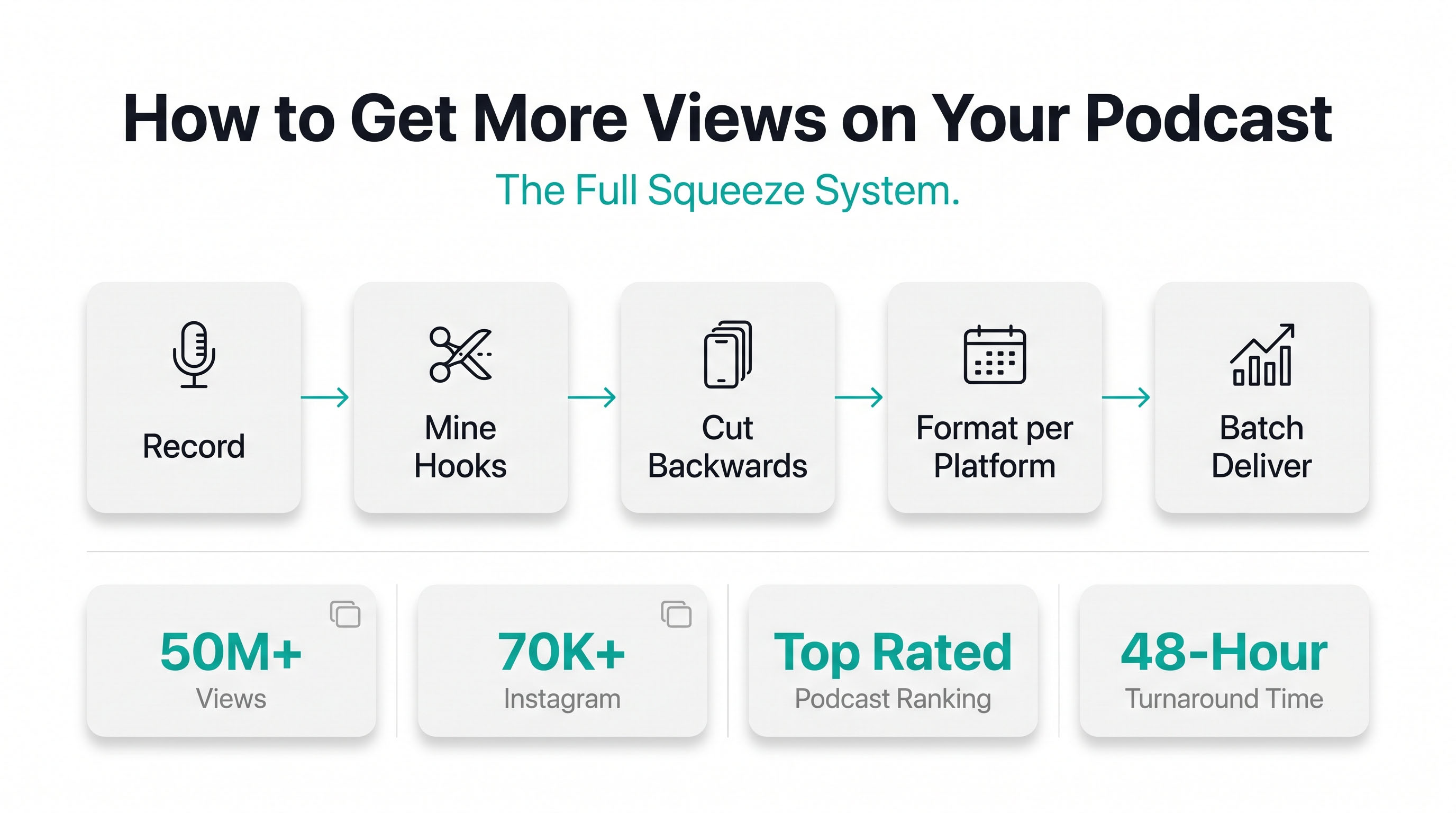
We built something to fix this. We call it the Full Squeeze System — because that's literally what it is. You already paid for the recording, the guest, the setup, the energy in the room. Full Squeeze means nothing gets left on the table.
Why "Just Editing It Yourself" Stops Working
Nobody plans to fall behind on clips. It happens by accident, one week at a time. You post five clips one week because you had a free Sunday, then zero the next three weeks because you didn't. Consistency dies quietly like that — not in one dramatic failure, but in a slow drift where editing keeps losing to everything else on your plate.
And even when you do carve out the time, most self-edited clips have the same problem: the good line is buried at second twelve, and nobody sticks around that long to find it. A scroll only gives you about a second and a half to earn attention. If your hook isn't sitting right at the front, the algorithm never gets the chance to show your best material to anyone.
None of this means your content is bad. It means editing without a system turns every single episode into a fresh, exhausting decision — what to cut, how long, which platform, what caption. That's not a workflow. That's forty new decisions a week you didn't sign up to make.
Inside the Full Squeeze: One Recording, Fifteen Pieces of Content
Here's the actual mechanics of it, the way we run it for clients every week.
We start by mining the episode for moments that already have a hook built in — a bold claim, a story with a turn in it, a disagreement, a specific number. We're not hunting for "good content." Good content is everywhere in a decent conversation. We're hunting for moments that can survive on their own, out of context, in someone's feed.
Every clip then gets cut backwards from its first three seconds. If the strongest line lands at 0:20, that line moves to 0:00. This sounds obvious written down. It's the single most skipped step in self-edited podcast content, and it's the reason so many creators feel like they're "doing everything right" and still not growing.
From there, nothing gets a one-size-fits-all export. A clip built for TikTok isn't the same clip built for LinkedIn — pacing, captions, even the length of a pause before a punchline changes by platform. And you get the whole batch at once. Not a trickle over two weeks while you wait on one editor's schedule. Fifteen clips, captioned, organized, ready to queue up and forget about.
The part people underestimate is what happens after episode three or four. We start seeing which formats actually land with your audience — not podcasters generally, yours specifically — and the system gets sharper every round. A joke format that flopped in episode two might be your best performer by episode six, once we know what your listeners respond to.
One honest caveat: fifteen is a ceiling, not a quota. A tightly packed episode might yield twenty clip-worthy moments. A quieter one might give you eight great ones instead of fifteen mediocre ones. We'd rather hand you eight clips that actually hit than pad the count with filler nobody watches past the hook.
The Receipts
We're not asking you to take any of this on faith. Auj Creative has generated 50M+ views across creator and business clients, built a 70K-follower Instagram doing exactly this kind of editing, and carries a Top Rated badge with a 100% Job Success Score across our project history. That's not a slide in a pitch deck — it's the same Full Squeeze process, run on repeat, for podcasters who came to us the same way you probably found this article: searching for a podcast video editing service that could actually move the views needle, not just deliver a file on time.
Turnaround matters just as much as the cut itself. A brilliant clip that lands three weeks late is worthless to a posting calendar. Every project moves on a 48-hour turnaround, so you're never sitting on unpublished content while your next episode is already recorded and waiting behind it.
Do the math on what that actually means for your show. One hour of recording, properly squeezed, becomes 10-15 pieces of short-form content. Post four or five a week and a single Tuesday afternoon in the studio just bought you a month of content — while everyone else is still trying to find two free hours between guest bookings to cut their own clips.
And views are where the money conversation actually starts. Sponsors don't sign off a download count anymore — they check your Reels, your Shorts, your TikTok engagement, because that's the inventory they're actually buying. A show posting fifteen sharp clips a month has a media kit that sells itself. A show posting one long episode a week is still trying to convince a brand to trust a number in an email. If you've been searching how to make money from a podcast in the same breath as how to get more views, this is the actual order of operations: views come first, and clips are what get you there.
This Isn't Just a US Problem
Whether your show is recorded in London, Toronto, Sydney, or LA, the feed doesn't care where you're based. Attention spans are identical, the platforms are the same four apps, and the podcasters actually growing right now — in any of these markets — are the ones treating clips as the main event, not the leftovers from a "real" episode.
If your current process is "record, then figure out the clips whenever I get a spare afternoon," you're not behind because your content is weak. You're behind because you're missing a system, and a system is the one thing separating shows that compound their audience from shows that plateau.
Picture two podcasters who recorded the exact same interview on the exact same day. One posts the full episode to YouTube and moves on. The other runs it through the Full Squeeze System and has fifteen clips scheduled across a month, each one hooked, captioned, and formatted for the platform it's landing on. Six months later, those two shows are not competing in the same league anymore — and the gap has nothing to do with who booked the better guest. It's entirely downstream of what happened to the recording after the mics turned off.
Quick Answers Before You Go
Do I need to change how I record? No. The Full Squeeze System works with whatever setup you already use — Riverside, StreamYard, a Zoom call, a studio. We're mining the footage you already have, not asking you to produce differently.
What if my episode is short, like 20 minutes? You'll get fewer clips, not worse ones. A tight 20-minute episode with three strong moments still gets you three sharp clips — better than fifteen watered-down ones from a rambling hour.
Can I still do parts of this myself? Sure. Some clients handle posting and scheduling in-house and just want the cuts. Others want the whole pipeline — cutting, captioning, and a content calendar. The system flexes to how hands-on you want to be.
Let's Squeeze Your Next Episode
You don't need to hire an in-house editor or lose your weekends to Premiere Pro. You need a process that's already proven, moving on a 48-hour clock, with numbers you can actually verify.
Head to aujcreative.com and get in touch through our contact page. Tell us about your show and your posting goals, and we'll walk you through exactly how the Full Squeeze System would work on your next episode.